The content on this page is to serve as a resource of pending federal legislation, information from national partners and relevant updates to the Child Care Development & Block Grant (CCDBG) law and to the Child Care and Development Fund (CCDF) updated as of March 20, 2024.Click here to go to Federal Code of Regulations PART 98 - CHILD CARE AND DEVELOPMENT FUND Click here to see Child Care Aware's one-pager on the CCDBG Click here to watch live US Senate Floor proceedings. Click here to watch US House of Representatives hearings. Click here to see the Notice of Proposed Rule Changes for CCDF (Updated: 08/30/26)_________________________________________________________________________________2026 CCDF UpdatesNEW SAVE THE DATES: 2028-30 CCDF State Plan Input Session CCDF State Plan Input Sessions:
Future listserv announcements like this by CDSS will be sent out with more information about future sessions in September and October, once locations are secured in other regions of the state. The future sessions will be either in-person or virtual. Public Charge Update - DHS Subregulatory Guidance Released From Protecting Immigrant Families Coalition (PIF): Yesterday, the Department of Homeland Security (DHS) released subregulatory guidance regarding the 2026 DHS final public charge rule, published on July 20th. Please see PIF’s statement on the subregulatory guidance here, and an updated entry on our Executive Tracker here. The final rule and new guidance will take effect on September 18, 2026. The subregulatory guidance, which is not subject to public comment, reiterates much of the final rule text and does little to clarify the ambiguities created by the final rule. It also explicitly replaces the 1999 field guidance. Public charge does not apply to everyone. However, this guidance leaves substantial questions unanswered about which programs and circumstances USCIS will consider and is likely to cause confusion and uncertainty. Families with questions about how the rule may affect a particular immigration case should consult a qualified immigration attorney or DOJ-accredited representative. The guidance:
The new rule and this more recent guidance will take effect September 18, 2026. Until then, the 2022 public charge rule remains in effect. Federal Public Charge Final Rule On July 16, 2026, the U.S. Department of Homeland Security (DHS) published a Final Rule revising how immigration officials determine whether an individual is likely to become a "public charge" when applying for lawful permanent resident (green card) status or certain visas. The rule rescinds the 2022 public charge regulations and restores broader discretion for immigration officers to evaluate an applicant's likelihood of relying on public assistance. The Final Rule is scheduled to take effect on September 18, 2026. You can read the What Child Care Programs and Families Need to Know:
Joint Statement from California Health and Human Services Leaders on New Federal Public Charge Rule: "The California Health and Human Services Agency and its Departments are reviewing the federal government’s final Public Charge Rule and assessing the potential impacts on California families and communities. As indicated in the federal government’s notice, the final Public Charge Rule will take effect 60 days after formal publication on the Federal Register. In other words, the final rule will take effect in mid-September. The federal notice also states that means-tested public benefits received before the rule’s effective date will not be considered under the new rule. Previously, cash-assistance for income maintenance and long-term institutionalization assistance were considered for public charge purposes and will continue to be considered. In addition, the federal notice explains that federal agencies will issue interim guidance soon. As we continue our review of the federal guidance and final rule, we will post information for Californians about what this rule means for them at CHHS.ca.gov." New Notice of Proposed Rulemaking: Federal Nonprofit Grant Rules On May 29, 2026, the U.S. Office of Management and Budget (OMB) proposed sweeping changes to overhaul the set of rules, known as the Uniform Guidance, governing federal grants, cooperative agreements, and other monetary awards to nonprofits, state and local governments, and other grantees. Click here to read the proposed rule. What Nonprofits Need to Know:
From the National Council of Nonprofits: "If implemented, the proposal would create significant financial risk and instability for federal grantees, making it more difficult to provide vital services to communities. The proposal attempts to grant unprecedented discretion to any administration to withhold, suspend, or terminate grants, or change terms and conditions mid-performance, forcing grantees to operate in a shifting environment. The proposal would allow an administration to determine federal awards based on partisan ideology, rather than objective criteria, community needs, and congressional intent, while decreasing public transparency throughout the process." NEW New Resources for Notice of Proposed Rulemaking Restoring Flexibility to Support Head Start Program Access On May 12, 2026, the U.S. Department of Health and Human Services (HHS) published a Notice of Proposed Rulemaking (NPRM) that would rescind portions of the 2024 Head Start workforce rule. Specifically, the proposal would remove federal requirements related to staff wages and benefits that were scheduled to take effect beginning in 2028 and 2031. HHS states the proposed changes would restore local flexibility and reduce costs for Head Start programs. Click here to read the proposed rule. What Head Start Programs Need to Know:
Actions You Can Take:
From the National Head Start Association: “A strong Head Start program is built on stability, and that stability comes from a consistent and qualified workforce. Teachers, family service staff, bus drivers, and program leaders who show up every day for hundreds of thousands of eligible children and families are the heart of this program, and we must do everything we can to recruit, retain, and support them, including paying them a competitive salary.” The Administration for Children and Families (ACF) at the U.S. Department of Health and Human Services on May 11, 2026 announced a child care reform package to lower costs, expand access, and better serve families who rely on federally-funded child care programs. Temporary Assistance for Needy Families (TANF) Information Memorandum: Encourages states to transfer more TANF funds to Child Care and Development Fund (CCDF) to expand child care access and clarifies that TANF can support needy married two-parent families in which one parent works and the other cares for a child at home. CCDF Dear Colleague Letter: Clarifies that faith-based providers and family, friend, and neighbor caregivers can play a larger role in federally supported child care, which can expand parent choice and reduce unnecessary barriers for the trusted providers and caregivers many families already rely on. Final Rule, Restoring Flexibility in the Child Care and Development Fund (CCDF): Rescinds Biden-era policies that pushed states toward grants and contracts over parent-directed vouchers, restoring state flexibility, parental choice, and stronger safeguards against waste, fraud, and abuse. Notice of Proposed Rulemaking (NPRM), Restoring Flexibility to Support Head Start Program Access: Proposal to remove burdensome Biden-era personnel mandates, including wage and benefit requirements, that would have raised provider costs, reduced available slots, and limited access for children and families. To highlight these actions, ACF sent a letter to all governors urging states to use every available CCDF and TANF flexibility to expand child care access, support married two-parent families, and respect parents’ child care choices — especially for families who choose to have a parent remain at home with young children. Child Care Aware of America Federal Legislation Tracker FRAC's Resources and Response to the Senate's Passage of the Farm Bill From the Food Research & Action Center (FRAC): The Food Research & Action Center (FRAC) is deeply troubled that the House of Representatives passed a Farm Bill (224–200) that fails to reverse the $187 billion in Supplemental Nutrition Assistance Program (SNAP) cuts enacted under the budget reconciliation law, H.R. 1. This vote is especially concerning given that some Democrats who opposed reconciliation due to these cuts ultimately supported this Farm Bill. SNAP cuts are inflicting widespread harm on millions of Americans, particularly children, older adults, parents, veterans, the unhoused, people with disabilities, and working families who are increasingly experiencing empty cupboards, missed meals, and impossible choices between food, rent, and medicine as costs to meet basic needs continue to rise. The colossal failure to undo the cuts are also impacting farmers and food retailers. These challenges are compounded by states facing a significant increase in their share of SNAP administrative costs, which will rise from 50 percent to 75 percent starting in fiscal year (FY) 2027, as well as, for the first time, covering a portion of SNAP benefits starting in FY 2028. These cost shifts will force states to make the impossible choices of cutting eligibility for individuals and families; raising taxes; or cutting other essential services. Some states will be unable to absorb these costs at all, putting the future of SNAP itself at risk and leaving a trail of hunger, malnutrition, and economic turmoil. We urge the leadership of the Senate and others who are working on farm relief, to reject the House bill and instead proceed, in the strong bipartisan tradition, with legislation that prioritizes families struggling to put food on the table and the needs of American farmers. FRAC will not support any Farm Bill that fails to address our nation’s deepening hunger crisis. Let us be clear: No Farm Bill is better than a bad one. FRAC resources to support your Senate advocacy: California judge issues injunction blocking feds from freezing $10 billion in child care funding A federal judge in California Tuesday issued an injunction preventing the government from cutting off $10 billion in child care and housing funds for five Democratic-led states. It’s the latest ruling prohibiting the Trump administration from implementing a freeze on the states’ Administration for Children and Families funding. Read more here. In a ruling from the bench, U.S. District Judge Trina Thompson said the plaintiffs are likely to succeed on the merits of their claim the government did not follow the required legal process when it announced it would be freezing funds for three public welfare programs in New York, California, Colorado, Illinois and Minnesota over potential concerns of fraud. CCDBG Reauthorization Bill Discussion Draft Recently, Senator Cassidy (R-LA), Chairman of the Senate HELP Committee:
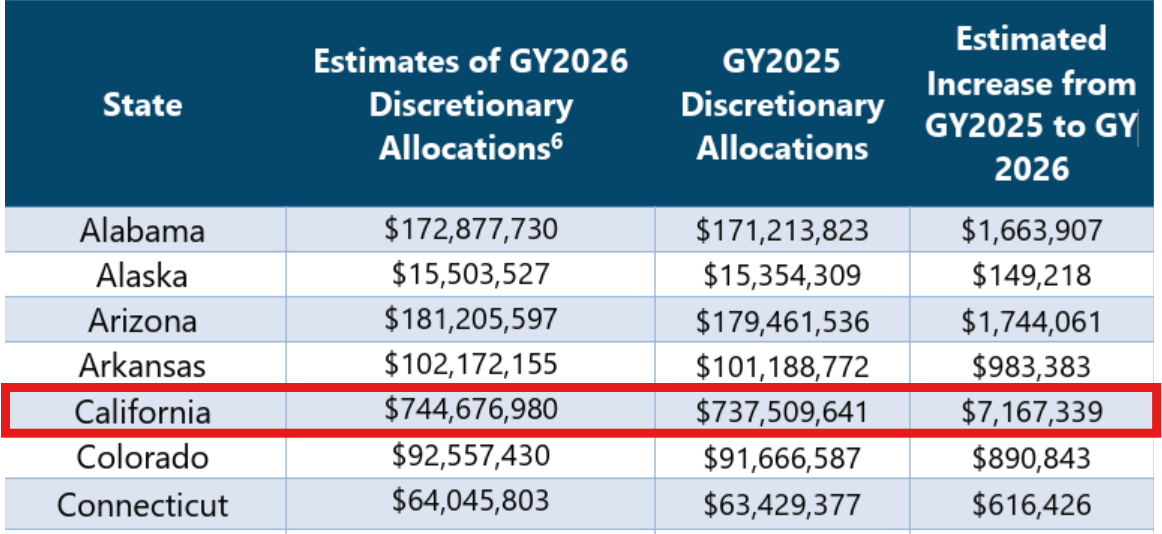
The proposed reauthorization bill has numerous harmful provisions, but some toplines are: prohibits enrollment-based payments, presumptive eligibility, and timely payments; eligibility is changed from 12 months to 6 months; eligibility requires that parents be citizens rather than the child; lowers the income limit for single mothers; and initiates work requirements for married couples. This, in addition to many concerning anti-“fraud” provisions. At a time when families need more help with child care, the bill manages to penalize single moms, married couples, children, early educators, and mixed-status families. CLASP Estimates California Will Have a $7M Increase in FY26 CCDBG Funding Discretionary Allocation On February 3, 2026 Congress approved a $85M increase to the Child Care and Development Block Grant (CCDBG) in the FY 2026 appropriations process. Unfortunately, this small increase does not keep pace with inflation and ultimately falls short of the $160M needed to ensure there are enough resources to serve all children currently accessing care through CCDBG. In a recent report, CLASP estimates that California's estimated distribution for Grant Year (YR) 2026 CCDBG discretionary funds will be $755,676,980, or roughly a $7M increase from 2025. See the chart below pulled from the report. For questions, please contact Rachel Wilensky at [email protected].
Federal Child Care Legislation in the 119th Congress (2025-26) CCDF Program Integrity and Fraud On Thursday, March 5, 2026 the Education and Workforce Committee passed 8 bills aimed at cracking down on fraud, strengthening oversight, and protecting taxpayer dollars in federal child care assistance programs. Read the committee's summary here. • The Child Care Payment Integrity and Fraud Accountability Act (H.R. 7720) proposes stronger oversight and accountability measures to ensure CCDF dollars are paid accurately and used as intended. • The CRACKDOWN Act (H.R. 7721) would set a 5 percent threshold for improper payments and require states exceeding it to implement corrective actions. • The Child Care Integrity Monitoring Act (H.R. 7722) would establish a formal three-year audit cycle for child care programs and subject repeat offenders to heightened oversight. • The Safeguarding Taxpayer Dollars in Child Care Act (H.R. 7723) proposes to strengthen safeguards around CCDF funding to prevent misuse and improve program integrity nationwide. • The No Waivers for Fraud Act (H.R. 7724) proposes that child care funds are protected by ensuring federal waivers cannot override safeguards when fraud is identified. • The Stop Child Care Fraud Act (H.R. 7725) would improve data sharing between state agencies to ensure fraud warning signs are detected and addressed. • The No Funds for Repeat Child Care Violations Act (H.R. 7726) proposes accountability measures by directing child care funding to providers that consistently meet program standards. • The Closing the Provider Fraud Gap Act (H.R. 7677) would direct the Government Accountability Office to identify vulnerabilities in direct payments to providers and recommend measures to prevent abuse. Direct Impact on Educators and Reimbursement • The Payment Integrity Act (S. 3862) would amend the CCDBG Act to require states to pay educators based on verified attendance rather than enrollment. This could significantly change how payments are calculated. • The Child Care Supply Tax Credit Act of 2025 (S. 3534) would create a new wage-based tax credit for educators, including family child care, with higher percentages for rural areas. • The Child Care Workforce and Facilities Act of 2025 (S. 169/H.R. 581) provides grants to expand the workforce and improve facilities in child care shortage areas. Comprehensive System Reform • The Child Care for Every Community Act (H.R. 5658) proposes a universal model with capped family costs and wage alignment for educators. • The Child Care for Working Families Act (S. 2295 / H.R. 4418) would limit child care costs to 7 percent of income for lower-income families and support significant wage increases. • The Child Care Modernization Act (S. 2828) would require states to use a cost estimation model to set reimbursement rates, reflecting the actual cost of providing quality care. • The Head Start for America's Children Act (S. 2819) would fully fund and expand Head Start to serve all eligible children, extend program hours to match working families’ schedules, increase educator pay, and invest in workforce, mental health, and facility improvements. Food, Nutrition, and Operational Support • The Child Care Nutrition Enhancement Act (S. 1420 / H.R. 2859) would eliminate the two-tier reimbursement system in CACFP for family child care homes. • The Early Childhood Nutrition Improvement Act (S. 1447 / H.R. 2818) would allow reimbursement for a third meal and simplify eligibility reporting requirements. Specialized Care and Tax Policy • The After-Hours Child Care Act (S. 3845) would provide incentives for care during nontraditional hours. • The Improving Child Care for Working Families Act of 2025 (H.R. 5558) would increase Dependent Care Assistance Program (DCAP) limits for families. • The Stronger Start for Working Families Act (S. 3596) would expand access to the Child Tax Credit. Past and Upcoming Federal Hearings
Federal Judge Orders ACF to Release CCDF Funds Until Lawsuit Concludes A federal lawsuit brought by New York and several other states challenges the Administration for Children and Families’ decision to withhold billions of dollars in child care and social service funding, arguing the action was unlawful and would harm families. U.S. District Judge Vernon Broderick has blocked the federal government from enforcing the funding freeze, ordering that the money continue to flow while the case proceeds. The funds support critical programs such as child care subsidies and other safety-net services that help stabilize families and support working parents. In his ruling, the judge found that allowing the freeze to move forward could cause immediate and widespread disruption to services relied on by millions of families. The order is a preliminary injunction, meaning it stays in effect for the duration of the lawsuit unless it is changed by the court or overturned on appeal. While the case itself is still ongoing, the decision ensures that states can continue operating these programs without interruption for now. History of CCDF Funding Freeze:
On January 6, 2026, the Administration for Children and Families (ACF) informed Governor Newsom that the ACF is restricting drawdown for all Child Care Development Fund (CCDF) funds and Temporary Assistance for Needy Families (TANF) provided by ACF until further notice. Additionally, the ACF sent a letter to Governor Newsom freezing any additional drawdown of Social Services Block Grant (SSBG) funds.
President Trump Signs Federal Appropriations Package, DHS Negotiations Continue 02/05/26 President Trump signed the appropriations package (H.R.7148 - Consolidated Appropriations Act, 2026) passed by the House and Senate. All full-year appropriations bills with the exception of the Department of Homeland Security (DHS) have now been passed. DHS has flat funding through a continuing resolution that will expire February 13. Click here for the Labor, Health and Human Services, Education, and Related Agencies (LHSS) bill summary. Included in the LHSS bill was:
Click here to view the congressional appropriations status tracker, including the Labor-HHS-Education bill. Proposed Federal RuleNotice of Proposed Rulemaking (NPRM): Restoring Flexibility in the Child Care and Development Fund (CCDF) Public comment closed on February 4th EOD. On January 5th, 2025, the Department of Health and Human Services (HHS), Administration for Children and Families (ACF) released a proposed federal rule that proposes to amend the Child Care and Development Fund (CCDF) regulations (45 CFR part 98) to reduce costs and burden for states and territories administering the CCDF program. The rule proposes rescinding the four requirements outlined in the 2024 ACF final ruling which instructed Lead Agencies (such as the Dept. of Social Services in California) to implement the following:
The proposed rule gives states the choice to continue implementing these policies if they choose. It does not instruct states to rescind these policies.
______________________________________________________________________________________________________________________2025 Federal Budget Reconciliation
2025 Actions & Directives
2025-27 California State PlanIntroductionThe federal Child Care and Development Fund (CCDF) is an aggregate of several funding sources that is distributed in block grants by the federal government to the states and territories. The majority of the funds are to be used to provide child care services to families who meet certain income and need criteria. A portion of the funding is to be used for activities to improve the quality of child care. Another portion is to be used to pay for costs of administering the CCDF. The purpose of the CCDF is to increase the availability, affordability, and quality of child care services. States and territories receiving CCDF funds must prepare and submit to the federal government a plan detailing how these funds will be allocated and expended. Federal Fiscal Years (FFY) 2025–27
______________________________________________________________________________________________________________________Federal Organizations Tracking Child Care and Early Education:
___________________________________________________________________________
|